

The phrase minimum distributions table refers to the official tables published by the IRS for a specific purpose: calculating your Required Minimum Distribution (RMD) each year. These tables, most commonly the Uniform Lifetime Table, provide a "life expectancy factor" based on your age.
This factor is the key input for a simple formula that determines the amount you are required to withdraw from your tax-deferred retirement accounts. Understanding how this works is a foundational element of a thoughtful retirement income plan.
Deconstructing Required Minimum Distributions
Required Minimum Distributions, or RMDs, are a standard feature of holding a tax-deferred retirement account. They represent the point at which the government begins to collect taxes on funds that have grown without taxation for decades. The RMD rules compel withdrawals, which in turn create taxable income.
It is helpful to see RMDs not as a penalty, but as a predictable and manageable component of a sound financial plan. The rules are clear and the calculations are straightforward. This process is a normal part of the transition from accumulating assets for retirement to drawing upon them for income.
A Framework for Understanding RMDs
Instead of viewing RMDs as a compliance task, consider them a component of your retirement income strategy. They are a known quantity—a specific amount of capital that you know will become available each year. This knowledge allows for thoughtful planning in several key areas:
- Tax Management: Because RMDs increase your taxable income, a corresponding plan to manage the tax impact is essential.
- Cash Flow Integration: This required withdrawal can be timed and integrated to cover living expenses, making it a reliable part of your income stream.
- Investment Strategy: Knowing that withdrawals are required allows you to ensure your portfolio maintains sufficient liquidity, avoiding the need to sell assets at inopportune times.
Ultimately, becoming familiar with how the minimum distributions table functions places you in a position of control. It transforms a regulatory requirement into a manageable piece of your financial picture. You can learn more about how different retirement accounts operate in our other guides. With this understanding, you can manage your distributions with confidence.
How to Find the Right RMD Table for You
The first and most important step in calculating your required minimum distribution is selecting the correct life expectancy table from the IRS. While it sounds simple, an error here can affect your entire calculation and lead to potential penalties. The IRS provides three distinct tables, each designed for a specific situation.
For most individuals, the choice is straightforward—one standard table applies in nearly all cases. The other two are intended for more specialized, though still common, beneficiary circumstances.
One can either allow RMDs to become a source of confusion or integrate them as a manageable part of a financial plan. The difference lies in having a clear strategy.
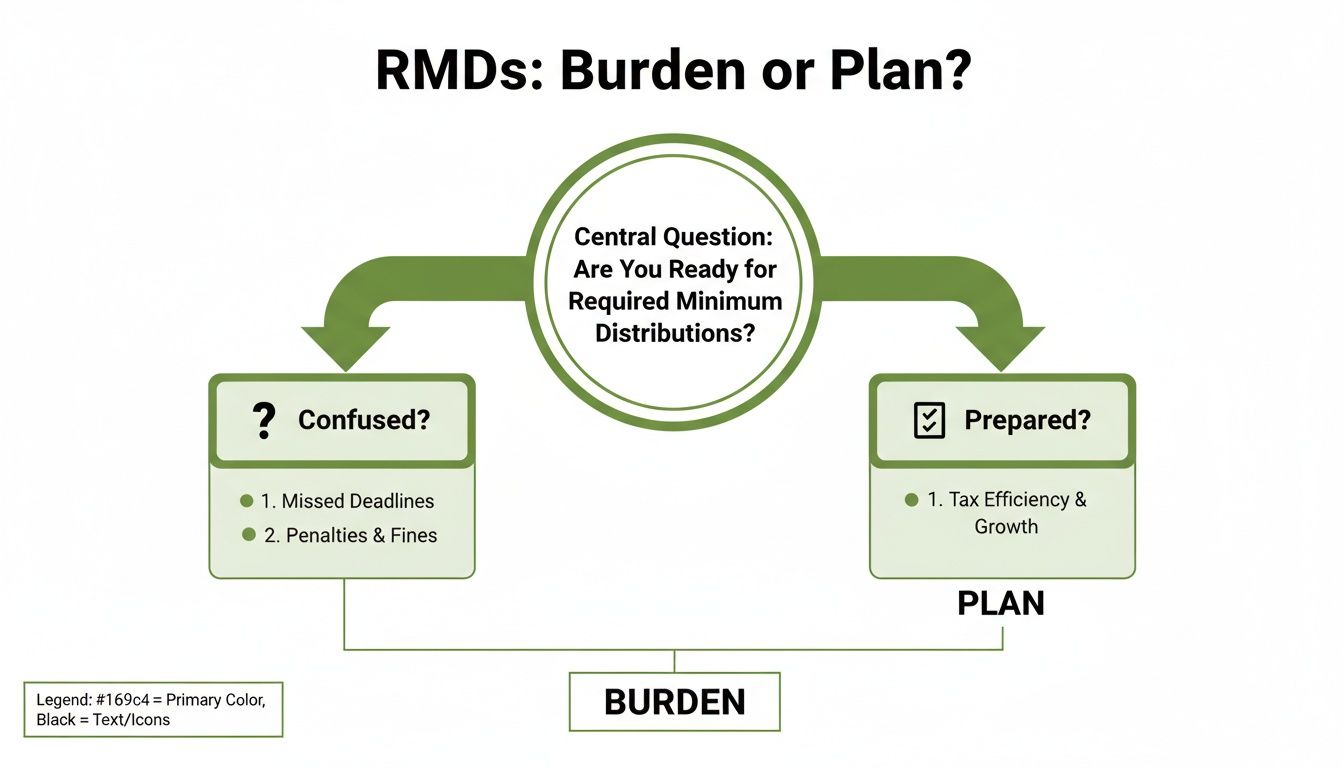
As the diagram suggests, a degree of foresight is beneficial. Let's clarify which table to use.
The Three IRS RMD Tables
Your choice of table is determined by a single key factor: your designated beneficiary. The individual you have named to inherit the account directly dictates which set of figures you will use for your calculation.
To simplify this, the following reference guide can help you identify the correct one.
Which RMD Table Applies to You?
| Your Situation | Applicable IRS Table | Primary Use Case |
|---|---|---|
| You are unmarried. | Uniform Lifetime Table | Calculating your own RMDs during your lifetime. |
| You are married, and your spouse is not more than 10 years younger than you. | Uniform Lifetime Table | Calculating your own RMDs during your lifetime. |
| You are married, and your spouse is the sole beneficiary of your IRA. | Uniform Lifetime Table | Calculating your own RMDs during your lifetime. |
| You are married, your spouse is your sole beneficiary, and your spouse is more than 10 years younger than you. | Joint Life and Last Survivor Table | A specific exception that allows for a smaller RMD. |
| You are a beneficiary who has inherited an IRA. | Single Life Table | Calculating RMDs from an inherited account. |
Let's explore the purpose of each table in more detail.
Table 1: Uniform Lifetime Table
This is the primary table for RMDs. The Uniform Lifetime Table is the default for nearly every retirement account owner. You will use this if:
- You are single.
- You are married and your spouse is not more than 10 years younger than you.
- You are married and your spouse is more than 10 years younger, but they are not the sole primary beneficiary of the account.
In essence, if your circumstances do not match one of the specific situations below, this is the appropriate table.
Table 2: Joint Life and Last Survivor Expectancy Table
This table is a specific exception designed for couples with a significant age difference. You only use the Joint Life and Last Survivor Table if your spouse is your sole beneficiary for the entire year and is more than 10 years younger than you.
The advantage of this table is its use of a longer joint life expectancy, which results in a smaller RMD. This allows more capital to remain in the account and continue its tax-deferred growth.
Table 3: Single Life Expectancy Table
The Single Life Table is used after the original account owner has passed away. Beneficiaries use it to calculate RMDs on an inherited IRA. Both spousal and non-spousal beneficiaries will refer to this table to determine their annual distribution requirements based on their own life expectancy.
It is important to remember that choosing the right table is not a strategic decision, but a matter of following the rules. Your marital status, beneficiary designation, and your beneficiary's age are the facts that determine the correct table. Accuracy from the start is key to maintaining compliance and avoiding unnecessary complications.
A Detailed Look at the Uniform Lifetime Table
For the vast majority of retirement account holders, the Uniform Lifetime Table is the instrument used to determine the annual required minimum distribution (RMD). It serves as the default table for most individuals.
It applies if you are unmarried, or if you are married and your spouse is not your sole beneficiary. It also applies if your spouse is your sole beneficiary but is less than 10 years younger than you. Because it covers so many common scenarios, understanding this table is a key part of managing your retirement finances.
How the Table Works in Practice
The Uniform Lifetime Table is a simple chart from the IRS that pairs your age with a "distribution period"—sometimes called a life expectancy factor. This number represents the average remaining lifespan for a person of your age, according to government data.
To calculate your RMD, you need only two pieces of information:
- Your retirement account balance as of December 31st of the previous year.
- The distribution period for your age in the current year.
The formula is simple: Account Balance ÷ Distribution Period = RMD. It is designed to be straightforward.
The logic behind the table is intuitive. As you get older, the distribution period decreases. A smaller divisor results in a larger withdrawal as a percentage of your account. This is the IRS’s mechanism for ensuring you methodically withdraw—and pay taxes on—your tax-deferred savings over your remaining lifetime.
For example, at age 75, the distribution period is 24.6. A decade later, at age 85, it drops to 16.0. This predictable decline helps you plan for how your mandatory withdrawals will grow over time.
It is useful to think of the distribution period not as a personal prediction of one's lifespan, but simply as a standardized number for a tax calculation. It is a tool for compliance, creating a consistent, age-based system for everyone.
Recent Updates and Their Implications
This is not a static document; the IRS periodically updates the life expectancy data to reflect increasing longevity. The most recent updates increased the distribution period factors for every age.
While this may seem like a minor adjustment, it has a tangible impact. A larger factor results in a smaller required withdrawal for that year. This allows more of your assets to remain in the account, where they have the potential for continued growth. It is a subtle but welcome change for retirees.
Let's examine how the withdrawals accelerate over time. Under the current table:
- At age 74, the factor is 25.5.
- At 80, it is 20.2.
- By age 90, it is down to 12.2.
- At 100, it is just 6.4.
Consider the impact on a $500,000 IRA. At age 80, your RMD would be $24,752 ($500,000 ÷ 20.2). If the balance remained $500,000 at age 90, your RMD would increase to $41,015 ($500,000 ÷ 12.2)—a 65% increase. This illustrates how significantly withdrawals can increase in later years.
These newer tables, updated following the SECURE Act, reflect improved mortality data. At age 80, for instance, the factor is 2.1 years longer than it was previously, which can initially lower RMDs by 8-12%. You can always review the latest IRS guidance on RMD calculations to see the most current data.
IRS Uniform Lifetime Table Excerpt
For a quick reference, here is a small sample from the Uniform Lifetime Table. It shows how the distribution period diminishes with age.
| Age | Distribution Period |
|---|---|
| 75 | 24.6 |
| 80 | 20.2 |
| 85 | 16.0 |
| 90 | 12.2 |
| 95 | 8.8 |
Once you know how to locate your age and its corresponding factor, a once-daunting regulatory requirement becomes a simple and repeatable part of your annual financial routine.
A Step-by-Step RMD Calculation Example
Observing the numbers in practice is often the best way to become comfortable with the RMD process. Let's walk through a straightforward example to demonstrate exactly how it is done. After performing the calculation once or twice, it becomes a simple year-end task.
For this example, we will use the Uniform Lifetime Table, which is the one most retirees will use.
The Three Necessary Data Points
Before you can perform the calculation, you need to gather three key pieces of information. With these in hand, the math is simple.
- Your Age: You will need your age as of the end of the year for which you are taking the distribution.
- Prior Year-End Account Balance: This is the total value of your retirement account on December 31 of the previous year.
- The Correct Distribution Period: This is the life expectancy factor you will find in the appropriate minimum distributions table.
That is all. Once you have these three items, you are ready to determine your RMD for the current year.
A Practical Walkthrough
Let's apply this to a real-world scenario. Assume you are 73 years old and your traditional IRA had a balance of $1,000,000 on December 31, 2025. Your RMD calculation is for the 2026 tax year.
First, you look up your age (73) on the IRS Uniform Lifetime Table (the one updated in 2022). The table provides a distribution period of 26.5.
The calculation is simple division: $1,000,000 / 26.5 = $37,735.85.
This means you must withdraw at least $37,735.85 from your IRA by the deadline of December 31, 2026. If you wish to explore this further, you can learn more about how life expectancy tables are used for retirement accounts.
The formula is as simple as it appears:
RMD = (Prior Year-End Account Balance) / (Distribution Period from IRS Table)
You will repeat this exact process each year, using your new account balance from the previous year-end and the new distribution period that corresponds to your current age.
A Note on Aggregating RMDs
What if you have more than one retirement account? This is where the rules require some attention, but they are quite clear.
For your traditional IRAs, you must calculate the RMD for each account separately. However, you are not required to take the withdrawal from each one. You can aggregate the individual RMD amounts and take the total withdrawal from a single IRA, or any combination of them.
This flexibility does not extend across different account types. For instance, the RMD for a 401(k) must come directly from that 401(k). You cannot satisfy it by taking a larger withdrawal from your IRA. The same principle applies to inherited IRAs—their RMDs must be calculated and taken separately from your own retirement accounts. Understanding these distinctions is crucial for proper compliance.
How Recent Law Changes Affect RMD Rules
The regulations governing retirement withdrawals are not static. Congress periodically passes new laws that can alter the landscape, and staying informed is important for sound financial planning. These shifts directly impact when you must begin taking withdrawals and how long your investments can continue to grow.
Recently, two major pieces of legislation—the SECURE Act and SECURE 2.0—have significantly updated the RMD framework. These were the most substantial updates in decades, enacted in response to increasing longevity and changing retirement patterns. For anyone planning their financial future, these changes provide additional time for tax-deferred growth.
The RMD Start Date Continues to Shift
The most discussed change is the age at which you must begin taking RMDs. For a long time, that age was 70½. The first SECURE Act pushed it to age 72.
SECURE 2.0 extended the timeline again, moving the age to 73 for anyone who turns 72 after December 31, 2022. The law also establishes another increase to age 75 for people born in 1960 or later. This means your birth year is now the key determinant of your RMD start date.
Delaying RMDs is a considerable advantage. Each additional year your assets remain in a tax-deferred account is another year they can compound without being taxed. Over time, that can make a meaningful difference in your account's value. Effective tax planning strategies are essential to make the most of this extended timeline.
The RMD Tables Have Been Updated
It is not just the starting age that has changed. The life expectancy tables used to calculate your RMD amount have been modernized to reflect that people are living longer. This is not the first time they have been adjusted, but a major update took effect in 2022, providing slightly longer distribution periods for everyone.
This change was driven by data. For instance, U.S. life expectancy for a 65-year-old increased from 18.7 years in 2000 to 19.5 years by 2022, and the tables needed to reflect this reality. For those interested in the details, the official government commentary on these updated life expectancy tables is available.
These legislative updates are more than minor administrative changes. They are a clear signal that retirement horizons are expanding, offering a valuable opportunity to refine your long-term financial plan.
Staying current with these rule changes is important. While the fundamental concept behind RMDs remains the same, the new timeline offers more flexibility and greater potential for growth before withdrawals must begin.
Integrating RMDs Into Your Financial Strategy

Determining your annual withdrawal using the RMD tables is a straightforward calculation. The more significant work lies in weaving that distribution into the broader context of your financial life. It is helpful to view your RMD not merely as a tax liability, but as a predictable cash flow that can be deployed thoughtfully.
When you begin to see your RMD as a core part of your retirement income plan, you can make more intentional decisions. It becomes a known variable around which you can build, helping you manage everything from your budget and tax strategy to your philanthropic goals. This shift in perspective can turn an obligation into an opportunity.
A comprehensive financial plan acknowledges that all pieces are connected. Your RMDs directly impact your taxable income, which in turn can affect how your Social Security benefits are taxed or the tax bracket for your other investment income. To integrate them properly, one must consider the entire financial picture.
Aligning Withdrawals with Your Goals
Instead of treating the RMD as a standalone task to be completed, consider it the first portion of your annual income. The funds must be withdrawn, so the primary decision becomes how to use them to best support your life and values.
This reframing opens several possibilities. For many, the RMD simply helps cover planned living expenses. For others whose needs are met by pensions or other income, the RMD presents a different set of choices regarding tax efficiency and legacy planning.
The question evolves from, "How much am I required to take out?" to, "What is the most thoughtful use of this required distribution?" This subtle but powerful mindset shift is a cornerstone of effective retirement planning.
This approach helps you see the distribution not just as a number from a minimum distributions table, but as capital you can direct with clear purpose.
Strategic Distribution Options
While a simple cash withdrawal is the most common method for satisfying an RMD, other options may better suit your financial situation, particularly if you have philanthropic goals.
One of the most effective tools available is the Qualified Charitable Distribution (QCD). This IRS provision allows individuals age 70½ and older to direct up to $108,000 (the limit for 2025) from their IRA to a qualified charity.
A QCD offers a significant benefit:
- The funds sent to the charity count toward satisfying your RMD for that year.
- Critically, that distribution is excluded from your adjusted gross income (AGI).
This income exclusion can be a powerful tool for managing your tax situation. By lowering your AGI, a QCD may help reduce the taxes you owe on Social Security benefits, lower your Medicare premiums, and preserve your eligibility for other deductions. For anyone who plans to give to charity, it is an exceptionally efficient method. For more ideas, our guide on how to reduce taxable income provides additional strategies.
Another, though less common, option is an in-kind distribution. This simply means you transfer assets—such as shares of stock or a mutual fund—from your IRA into a taxable brokerage account to meet your RMD. The fair market value of the assets is still taxed as ordinary income, but it can be a useful strategy if you wish to retain a specific investment for the long term without selling it.
Ultimately, integrating RMDs is about thinking ahead. By treating these withdrawals as a predictable part of your financial plan, you remain in control of your assets and ensure they continue to support your goals.
Common Questions About Minimum Distribution Tables
As one delves into the rules for required minimum distributions, many practical questions arise. Gaining clarity on the specifics can provide peace of mind and help you feel more confident about your retirement income strategy. Here are a few of the most common questions about using the RMD tables and managing withdrawals.
What Happens If I Fail to Take My Full RMD?
If you do not withdraw the full RMD amount by the deadline, a penalty may apply. The IRS can levy a 25% penalty on the amount that was not withdrawn.
This can be reduced to 10% if the mistake is corrected in a timely manner, generally within two years. While the deadline should be taken seriously, the IRS has a process for rectifying these errors. The key is to acknowledge the oversight and act promptly.
Are RMDs Required for a Roth IRA?
No. The original owner of a Roth IRA is never required to take RMDs. This is one of the primary advantages of Roth accounts over traditional, tax-deferred accounts like a 401(k) or a traditional IRA.
Because there are no RMDs, the funds in your Roth IRA can continue to grow tax-free for your entire lifetime, offering considerable flexibility. It is important to note that beneficiaries who inherit a Roth IRA are typically subject to their own set of distribution rules.
Can My RMD Be Reinvested Into an IRA?
Once you take an RMD from a retirement account, you cannot return it or roll it over into another IRA. The withdrawal is final for the tax year and, in most cases, is counted as taxable income.
You can, of course, invest that money in a taxable brokerage account. The primary rule is that it cannot be returned to any tax-advantaged retirement account.
How Does Market Volatility Affect My RMD Calculation?
Your RMD for the year is calculated based on a single data point: your account's value on December 31st of the prior year. Market performance in the current year does not alter the dollar amount you are required to withdraw.
This can sometimes lead to counterintuitive outcomes. For instance, if the market declines sharply after the valuation date, your RMD will represent a larger portion of your now-smaller portfolio. Conversely, if the market rises, your RMD will be a smaller percentage of your current balance.
This rule highlights the importance of a long-term perspective. The fixed calculation provides certainty for tax planning, but it is also a reminder that short-term market fluctuations can change the real impact of your withdrawal.
This rigid method is simply how the minimum distributions table system is designed—it prioritizes consistency over market timing. A sound withdrawal strategy acknowledges this and plans accordingly, ensuring sufficient cash is available so that one is not forced to sell assets at an inopportune time.
A structured financial plan provides the clarity and discipline needed to manage retirement complexities with confidence. As fiduciaries, Wealth Accel is committed to providing objective advice that aligns your entire financial life—from investments and retirement income to tax strategy—with your most important goals. Schedule a conversation to learn how our process can help you move forward. Learn more about our approach at https://wealthaccel.com.
Generated with the Outrank app